
What is a Periodontal Chart?
Periodontal charting meticulously documents the health of supporting oral structures, creating a vital record of a patient’s periodontal condition.
This periodontal chart, often found as a periodontal chart PDF, displays clinical data like probing depths and attachment levels across all teeth or implants.
It’s a crucial tool for tracking changes over time, enabling effective treatment planning and ongoing maintenance of oral health.
Definition and Purpose
A periodontal chart is a comprehensive, structured document meticulously detailing the health status of a patient’s periodontal tissues – the gums and supporting structures around the teeth. Frequently utilized as a periodontal chart PDF for easy storage and sharing, it serves as a critical baseline for assessing oral health.
Its primary purpose is to record key clinical measurements, including probing depths, attachment loss, gingival margin levels, furcation involvement, and tooth mobility. This detailed documentation allows dental professionals to accurately diagnose periodontal diseases like gingivitis and periodontitis.
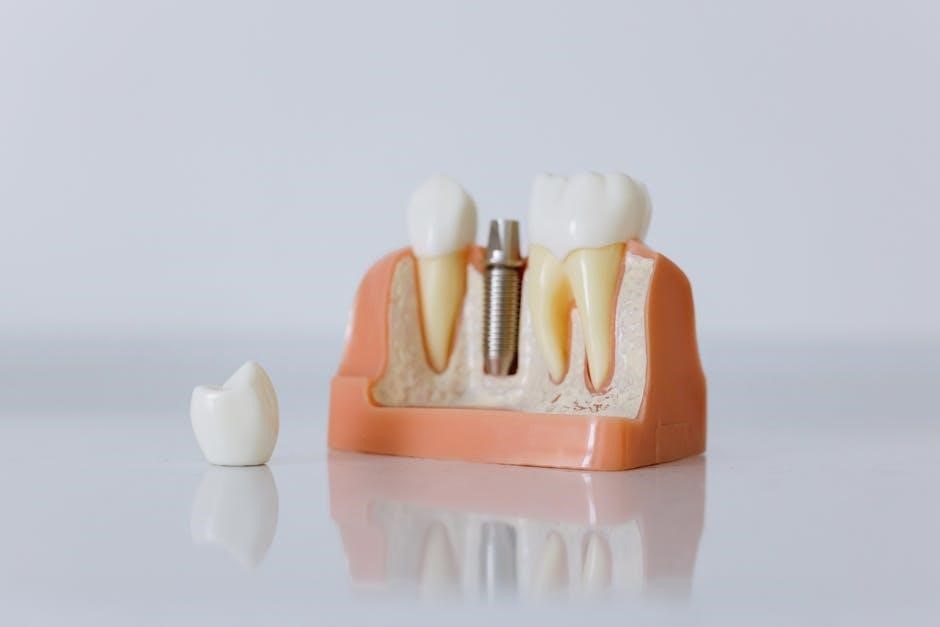
Beyond diagnosis, the chart facilitates tracking disease progression over time, comparing pre-treatment conditions with post-treatment results and monitoring the effectiveness of ongoing maintenance. This longitudinal data is invaluable for informed treatment planning and ensuring optimal patient care. The chart displays clinical data on six sites per tooth or implant.
Importance of Periodontal Documentation
Thorough periodontal documentation, often maintained as a periodontal chart PDF, is paramount in modern dental practice. It’s not merely a record, but a legal and clinical necessity, providing a clear picture of a patient’s oral health over time.
Accurate charting allows for effective communication between dental professionals, ensuring continuity of care. It supports informed treatment decisions, justifying procedures to insurance providers and patients alike. Detailed records enable comparison of periodontal health across different phases – pre-treatment, re-evaluation, and recall maintenance.
Furthermore, comprehensive documentation is crucial for medicolegal protection, demonstrating the standard of care provided. The ability to track changes in probing depths and attachment levels, as displayed on the chart, highlights disease progression or stability. This ongoing record is essential for proactive patient management and long-term oral health.

Components of a Periodontal Chart PDF
A standard periodontal chart PDF includes essential elements: tooth numbering, site markings, probing depths, attachment loss, gingival margin levels, furcation involvement, and tooth mobility assessments.
Basic Chart Elements: Tooth Numbering & Site Marking
Tooth numbering systems are foundational to any periodontal chart PDF, ensuring clear identification of each tooth. Commonly, the Universal Numbering System is employed, assigning each tooth a number from 1 to 32. Accurate tooth identification is paramount for consistent and reliable charting.
Site marking divides each tooth into specific locations around its circumference to assess periodontal status. Typically, six sites are recorded per tooth – mesiobuccal, buccal, distobuccal, mesiolingual, lingual, and distolingual. These sites allow for detailed evaluation of probing depths, attachment loss, and gingival margin levels;
Precise site marking is crucial for tracking changes and identifying localized areas of disease progression. The periodontal chart visually represents these sites, enabling clinicians to pinpoint specific areas requiring attention during treatment planning and monitoring. Consistent application of these basic elements ensures a comprehensive and accurate periodontal assessment.
Probing Depths and Attachment Loss
Probing depths, a core component of a periodontal chart PDF, measure the space between the gingival margin and the base of the periodontal pocket; These measurements, recorded in millimeters, indicate the extent of periodontal disease. Increased probing depths signify deeper pockets and potential bone loss.
Attachment loss reflects the destruction of the periodontal supporting tissues. It’s calculated by adding the probing depth to the recession distance, revealing how much attachment has been lost from the original baseline. This metric is vital for assessing disease severity and tracking progression.
Accurate recording of both probing depths and attachment loss on the periodontal chart allows clinicians to monitor changes over time, evaluate treatment effectiveness, and make informed decisions regarding patient care. These measurements are essential for comprehensive periodontal diagnosis and management.
Gingival Margin Levels
Gingival margin levels, meticulously documented within a periodontal chart PDF, represent the position where the gum tissue meets the tooth surface. These measurements, typically recorded in millimeters, are crucial for assessing gingival health and identifying potential inflammation or recession.
Recording gingival margin levels allows clinicians to establish a baseline and monitor changes over time. Variations from the normal position can indicate gingivitis or periodontitis, signaling the need for intervention. Accurate documentation is essential for tracking the response to treatment.
On a comprehensive periodontal chart, these levels are noted at specific sites around each tooth, providing a detailed picture of the gingival condition. This data, combined with probing depths and attachment loss, contributes to a complete periodontal assessment and informs effective treatment planning.
Furcation Involvement
Furcation involvement, a critical component recorded on a periodontal chart PDF, assesses the degree of bone loss around multi-rooted teeth – typically molars and some premolars. This evaluation determines if the supporting bone has receded to the point where the root trunk divides, creating a “furcation” area susceptible to inflammation and further destruction.
Clinicians use a grading system (often I, II, or III) to document the extent of furcation involvement, with higher grades indicating more severe bone loss and compromised tooth support. Accurate charting of furcation areas is vital for prognosis and treatment planning.
Within a detailed periodontal chart, furcation involvement is noted alongside other parameters like probing depths and attachment loss, providing a comprehensive view of periodontal health. Early detection and documentation of furcation issues are essential for preserving tooth structure and preventing tooth loss.
Tooth Mobility
Tooth mobility, a key indicator of periodontal health, is meticulously documented on a periodontal chart PDF. Assessing how much a tooth moves within its socket reveals the integrity of the supporting structures – the periodontal ligament, alveolar bone, and cementum.

Mobility is typically graded on a scale of 0-3, with 0 indicating normal physiological movement, and increasing numbers representing progressively greater movement. Grade I shows slight mobility, Grade II moderate, and Grade III significant mobility, potentially indicating a poor prognosis.
Recording tooth mobility within a comprehensive periodontal chart allows clinicians to track changes over time, correlating it with other parameters like probing depths and attachment loss. This data informs treatment decisions and helps predict long-term tooth stability. Consistent monitoring of mobility is crucial for effective periodontal management.

Creating and Using Periodontal Charts
Periodontal charts, often maintained as a periodontal chart PDF, can be created manually or digitally, streamlining workflows for dental professionals and enhancing patient care.
Manual vs. Digital Periodontal Charting
Periodontal charting traditionally involved paper-based charts, a manual process requiring meticulous handwriting and physical storage of periodontal chart PDF copies. While offering a tactile experience, manual charting is prone to errors, legibility issues, and inefficiencies in data analysis and retrieval.
Digital charting, conversely, utilizes software and applications to record and manage periodontal data electronically. This approach offers numerous advantages, including improved accuracy, enhanced data security, and simplified sharing of information between dental professionals. Digital systems often feature automated calculations, graphical representations of data, and integration with other practice management software.
The transition from manual to digital periodontal chart PDF systems reflects a broader trend towards technological advancement in dentistry, aiming to optimize workflows, reduce errors, and ultimately improve patient care. Modern solutions, like those offered by Denti.AI and Cliniccards, are transforming how periodontal health is assessed and monitored.
Software and Apps for Periodontal Charting (Denti.AI, Cliniccards)
Several software solutions are streamlining the creation and management of periodontal chart PDF documents. Cliniccards offers a dedicated tool within its treatment planning suite, allowing for convenient documentation of periodontal cases directly within the platform, capturing data like mobility, furcation involvement, and probing depths.
Denti.AI is at the forefront with AI-powered solutions. Denti Voice Perio has already facilitated over 1 million completed charts, demonstrating its efficiency. Furthermore, Denti.AI Detect, recently FDA cleared, utilizes AI imaging to amplify disease detection capabilities.
These applications move beyond simple data entry, offering features like voice-activated charting and AI-assisted analysis. They represent a shift towards more intelligent and efficient periodontal chart PDF workflows, improving accuracy and saving valuable chairside time for dental professionals.
Step-by-Step Guide to Completing a Periodontal Chart
Creating a comprehensive periodontal chart PDF begins with thorough photo documentation, capturing detailed images of the oral cavity for visual assessment. Next, systematically record probing depths at six sites per tooth or implant, noting attachment loss and gingival margin levels.
Assess and document furcation involvement where applicable, and evaluate tooth mobility using a standardized scale. Accurate data entry is crucial; modern software like Cliniccards simplifies this process within their treatment planning tools.
Digital solutions, including Denti.AI’s Voice Perio, can further streamline charting. Regularly updating the periodontal chart PDF – during initial exams, re-evaluations, and maintenance – allows for effective tracking of disease progression and informed treatment decisions.

Analyzing and Interpreting Periodontal Charts
Periodontal chart PDF analysis reveals areas of disease by identifying patterns in probing depths and attachment loss.
Tracking changes over time informs treatment planning and monitors the effectiveness of periodontal interventions.

Identifying Areas of Periodontal Disease
Periodontal chart PDF analysis allows clinicians to pinpoint specific locations affected by periodontal disease. Elevated probing depths, consistently exceeding 3-4mm, immediately signal potential issues. Examining attachment loss levels, recorded on the chart, reveals the extent of supporting tissue destruction around each tooth.
Areas exhibiting significant probing depths and substantial attachment loss are primary indicators of active periodontal disease. Furcation involvement, noted on the chart, highlights bone loss extending into the tooth’s root, demanding focused attention. Increased tooth mobility, also documented, suggests compromised periodontal support.
By meticulously reviewing these parameters within the periodontal chart PDF, clinicians can accurately identify pockets of inflammation, bone loss, and compromised tooth stability. This targeted approach is fundamental for developing effective, individualized treatment plans and preventing further disease progression. Visual assessment alongside the chart data enhances diagnostic accuracy.
Tracking Disease Progression Over Time
The true power of a periodontal chart PDF lies in its ability to monitor changes in periodontal health over successive examinations. Comparing charts from pre-treatment, re-evaluation, and maintenance phases reveals whether a patient is responding positively to therapy.
Increases in probing depths or attachment loss indicate disease progression, while decreases suggest successful treatment; Stable measurements signify maintained health. Consistent documentation within the periodontal chart PDF allows clinicians to objectively assess the effectiveness of interventions, like scaling and root planing.
This longitudinal data is invaluable for adjusting treatment strategies if necessary. It also serves as a powerful visual aid for patient education, demonstrating the impact of oral hygiene and professional care. The periodontal chart PDF provides a clear, quantifiable record of periodontal status, facilitating informed decision-making and improved patient outcomes.
Using Charts for Treatment Planning
A comprehensive periodontal chart PDF is fundamental to developing a tailored treatment plan. The detailed information regarding probing depths, attachment loss, furcation involvement, and tooth mobility guides clinicians in prioritizing areas of greatest need.
Identifying specific sites with significant attachment loss dictates the necessity for more aggressive therapies, such as surgical interventions. Conversely, areas with minimal disease may only require routine maintenance. The periodontal chart PDF facilitates a precise, targeted approach, avoiding unnecessary treatment.
Furthermore, the chart aids in determining the frequency of maintenance appointments and the specific procedures required – scaling, root planing, or periodontal surgery. It ensures a data-driven, patient-specific plan, maximizing treatment efficacy and long-term periodontal health. The periodontal chart PDF is, therefore, an indispensable tool for optimal care.

Periodontal Charting and Technology
Periodontal charting is evolving with AI, like Denti.AI Detect, and digital solutions enabling faster, more accurate periodontal chart PDF creation and analysis.
Denti Voice Perio has completed over 1 million charts!
AI-Powered Periodontal Charting (Denti.AI Detect)
Denti.AI Detect represents a significant leap forward in periodontal charting, utilizing groundbreaking FDA 510(k) cleared AI-powered imaging technology. This revolutionary solution amplifies disease detection capabilities, analyzing both intra- and extraoral dental images with remarkable precision.
Traditionally, creating a comprehensive periodontal chart PDF involved manual probing and recording, a process susceptible to human error and time constraints. Denti.AI Detect automates much of this process, identifying potential areas of concern – like deeper probing depths or attachment loss – directly from radiographic and clinical images.
This AI assistance doesn’t replace the clinician; rather, it enhances their diagnostic abilities, allowing for more focused examinations and ultimately, more effective treatment planning. The technology streamlines workflow, reducing charting time and improving the overall patient experience. It’s a powerful tool for creating accurate and detailed periodontal chart documentation.
Benefits of Digital Periodontal Charts (1 Million Charts Completed by Denti Voice Perio)
Denti Voice Perio has achieved a remarkable milestone, successfully completing over 1 million periodontal charts, demonstrating the widespread adoption and benefits of digital charting solutions. Transitioning from traditional paper-based methods to a digital periodontal chart PDF offers numerous advantages.
Digital charts enhance accuracy and legibility, eliminating the ambiguity often associated with handwritten notes. They facilitate seamless data sharing between dental professionals, improving collaboration and continuity of care. Furthermore, digital systems enable easy tracking of disease progression over time, allowing for informed treatment decisions.
The efficiency gains are substantial; charting time is reduced, and data analysis becomes more streamlined. Storing charts digitally also saves space and reduces the risk of lost or damaged records. Denti Voice Perio exemplifies how voice-activated technology simplifies the charting process, making it faster and more intuitive.